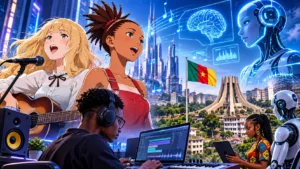
A future imagined on Mars
In 2019, Japanese filmmaker and anime director Shinichirō Watanabe introduced audiences to Carole & Tuesday, an animated series set on a futuristic Mars where artificial intelligence has become deeply integrated into everyday life. In this world, most music is produced by AI, while human musicians struggle to make their voices heard.
At the centre of the story are Carole and Tuesday, two young women who meet through their shared passion for music. In an industry increasingly dominated by automated production and manufactured pop stars, they choose to create music through their own experiences, emotions and musical collaboration.
The series presents a question that has become increasingly relevant in the real world: What happens when technology can produce music faster and more efficiently than human beings?
When Carole & Tuesday appeared, AI-generated music was already a subject of experimentation, but it had not yet become the everyday creative tool that it is for many people today. Generative AI can now help users create instrumental tracks, generate musical ideas, experiment with arrangements and produce songs from written descriptions.
Watanabe’s fictional world therefore offers more than science fiction. It provides a starting point for examining the relationship between technology, creativity and the future of the music industry.
https://www.netflix.com/title/80992137
For Africa, and Cameroon in particular, this transformation raises an important question: can AI become a tool for strengthening African music, or will African musicians find themselves competing against systems that reproduce their sounds without adequately recognising or rewarding their creators?
1. AI music is no longer science fiction
Artificial intelligence is changing the way music can be conceived, produced and distributed.
Today, AI-powered tools can help musicians generate musical sketches, experiment with genres, separate vocals from instrumentals, improve certain aspects of audio production and explore arrangements that might otherwise require additional equipment or collaborators.
A young artist without access to an expensive studio can use some of these tools to test musical ideas. An independent filmmaker can explore temporary soundtrack concepts. A producer can experiment with a fusion of makossa, jazz, electronic music and hip-hop before developing the final arrangement with musicians.
However, AI does not automatically produce a commercially successful song, and its results are not always musically coherent or culturally authentic. Human judgment, artistic direction and careful production remain essential.
The most important change is that certain stages of music production are becoming more accessible.
This does not mean that everyone will become a great musician. It means that more people may be able to experiment with music, develop demos and bring creative ideas to life without having to begin with a large financial investment. For independent artists, this could be significant.
2. The prediction of Carole & Tuesday: a world flooded with music
One of the most interesting ideas in Watanabe’s anime is that technological progress does not necessarily lead to greater artistic freedom.
In the series, AI-generated music dominates the industry. The problem is not simply that machines can compose music. It is that a musical environment dominated by automated production risks prioritising commercial formulas over individual expression.
This is where the anime becomes particularly relevant to today’s music industry.
If AI makes it possible to generate thousands of songs quickly, the world could face a new problem: an abundance of music competing for a limited amount of human attention.
Artists may find it increasingly difficult to stand out. Record labels, streaming platforms and audiences could encounter more music than they can realistically discover, evaluate or promote.
This creates a distinction between making music and building a musical identity.
AI can assist with production, but an artist still needs something that makes people care: a recognisable voice, a compelling story, a distinctive cultural perspective, meaningful performances and a relationship with an audience.
For Cameroonian musicians, this distinction matters. The goal should not be to generate more songs than everyone else. It should be to create music that people recognise as distinctive, emotionally meaningful and worth returning to.
In Carole & Tuesday, the two protagonists challenge a system dominated by AI by insisting on the value of human expression. Their story suggests that the future of music
you can see the opening here
3. Why AI could become an opportunity for Cameroonian music
Cameroon has a rich musical landscape, including makossa, bikutsi, assiko, bend-skin, mangambeu, gospel, hip-hop, Afropop and many other contemporary and traditional forms.
These musical traditions represent more than entertainment. They carry languages, histories, rhythms, social experiences and ways of understanding the world.
AI could help Cameroonian creators introduce these sounds to new audiences, provided the technology is used with cultural knowledge and respect for the people who created them.
A. Making music with limited resources
One of the practical barriers facing independent musicians is the cost of recording, production, promotion and distribution.
AI can help reduce some preliminary expenses by assisting with demos, musical sketches, arrangement ideas, promotional materials and content planning.
For example, a young artist in Yaoundé who wants to create a song combining bikutsi rhythms with electronic music could use AI to explore different production directions before working with a human producer to refine the composition.
The purpose would not be to replace the producer. It would be to make the initial creative process more accessible and focused.
Artists should also remember that AI-generated audio may require substantial editing, and that commercial use depends on the relevant platform’s terms and any rights affecting the material used.
B. Bringing Cameroonian sounds to international audiences
One of the most promising opportunities is the creation of music that combines local musical identities with contemporary global production.
Imagine a producer experimenting with a fusion of makossa, jazz and electronic music, or an independent artist creating a modern arrangement around a traditional rhythm.
AI could assist in exploring arrangements, tempos, textures and instrumental combinations. Human musicians would bring the cultural understanding and artistic decisions needed to make the final work distinctive.
Such experiments could appeal to audiences interested in African music, global fusion, film soundtracks and contemporary electronic music.
But this opportunity depends on originality. If African artists simply use AI to imitate international trends, they risk producing music that sounds interchangeable with thousands of other tracks.
The stronger strategy is to use technology to develop a sound rooted in Cameroonian experiences.
C. Supporting musicians who create in local languages
Cameroon is multilingual. Music is created in French, English, Pidgin English and numerous local languages.
AI-assisted workflows could help artists develop translations, subtitles, promotional descriptions and versions of their campaigns for different audiences. Speech and language tools may also assist with certain transcription and accessibility tasks.
For instance, a musician releasing a song in a local language could prepare subtitles and explanatory content to help listeners abroad understand the song’s meaning and cultural background.
However, language technologies do not understand every Cameroonian language equally well. Translations, pronunciation and cultural references should be checked by fluent speakers rather than accepted automatically.
The long-term opportunity is bigger than translation: African language data and locally developed tools could help ensure that African voices are represented in the technologies shaping future music.
D. Helping independent artists promote their work
Producing a good song is only one part of building a career. Artists must also find audiences.
AI can help independent musicians develop release calendars, brainstorm video concepts, prepare press releases, write social media captions and organise promotional campaigns.
A Cameroonian artist releasing a new single could use these tools to plan a campaign involving short performance videos, behind-the-scenes footage, interviews and stories about the song’s creation.
This is especially useful for independent artists who cannot afford a large communications team.
Nevertheless, automated promotion cannot replace a genuine connection with fans. Audiences still respond to personality, consistency, live performances, storytelling and authentic engagement.
4. The business opportunity: AI and the future of Cameroon’s music economy
The potential benefits of AI extend beyond singers and producers. They also create opportunities for entrepreneurs who understand music, technology and audience development.
Possible business models include:
* AI-assisted music production: providing affordable demos, arrangement support and production services, with clear disclosure of how AI is used.
* Music marketing services: helping artists prepare release campaigns, promotional videos, social media content and press materials.
* Audiovisual production: creating original soundtracks, advertising music and audio concepts for films, brands and digital content.
* Music education: teaching artists how to use AI responsibly in songwriting, production, promotion and business management.
* Cultural archiving: working with communities and musicians to document traditional songs, instruments, oral histories and musical techniques, with appropriate consent and access controls.
* African music technology: developing services that better understand local languages, rhythms, instruments and the needs of African music professionals.
These possibilities are particularly relevant to independent creators and small creative businesses.
A Cameroonian entrepreneur does not necessarily need to build an AI model from scratch. A business could begin by using existing tools to provide a specialised service to musicians, filmmakers, event organisers or advertising agencies.
The real commercial question is whether the service solves a problem people are willing to pay for.
For example, rather than selling generic AI-generated songs, a small creative studio could specialise in helping independent artists develop original music projects and deliver complete promotional campaigns.
That approach places value on human expertise, cultural knowledge and client relationships, not merely on access to software.
5. The danger: who owns the music created by AI?
The future imagined by Carole & Tuesday also invites us to examine the risks of AI in music.
One of the most important is copyright.
AI systems may be trained on existing music, raising questions about whether artists have consented to the use of their recordings and compositions, whether they should be compensated, and whether generated outputs improperly reproduce protected material.
Another concern is voice cloning. Technology can imitate a person’s voice, potentially allowing someone to create a recording that sounds like a famous singer without that artist’s permission.
For Cameroonian musicians, these risks should not be ignored.
An artist who uploads original recordings, unreleased songs or vocal samples to an AI service should understand the platform’s data policies, commercial-use terms and permissions. They should avoid uploading another artist’s recordings or cloning a recognisable voice without authorisation.
Musicians should also preserve original recordings, project files, dated demos, written agreements and records of their creative contributions. These materials can help establish how a work was created and support future disputes.
The legal position surrounding AI-generated music varies by jurisdiction and is still evolving. Artists should not assume that every AI-generated song is automatically copyright-free or that every output is eligible for copyright protection. For Cameroon, this creates a need for stronger copyright awareness, accessible legal guidance and discussions between musicians, producers, technology companies and policymakers.
The objective should be to encourage innovation while protecting the rights and livelihoods of the people whose work makes music valuable.
6. Could AI threaten African musical identity?
There is another issue that deserves attention: cultural appropriation through technology.
African music has influenced global popular culture for generations. Yet if AI systems do not adequately represent African musical traditions, they may reproduce a narrow understanding of what African music sounds like.
There is also a danger that systems could use traditional songs, rhythms or vocal styles without meaningful consent from their creators or communities.
This is especially important for musical traditions passed down orally, where the people who preserve the music may not have formal contracts or easy access to intellectual-property advice.
The answer is not to reject technology outright. It is to ensure that African musicians and communities participate in shaping it.
The AI & African Music pilot project announced by Wits University in 2025 illustrates one possible direction. Its goals included exploring AI tools shaped by African sounds, languages and musical practices, as well as using technology to preserve musical heritage. Source: Wits University.
For Cameroon, similar initiatives could involve musicians, traditional performers, archivists, researchers, software developers and cultural institutions.
Imagine a properly documented digital archive of Cameroonian musical traditions that supports education and creative research while respecting community permissions and agreed rights.
Such an initiative could help preserve cultural heritage while creating opportunities for future generations of artists and researchers.
7. What should Cameroonian musicians do now?
The most practical response is neither to fear AI nor to believe every promise made about it. Artists should experiment, learn and make informed decisions.
Here are five steps musicians can begin taking.
First, learn one useful tool at a time. Start with a clear need, such as generating demo ideas, separating audio stems, organising a release campaign or preparing promotional content. Evaluate whether the tool actually saves time or improves the result.
Second, protect your original work. Keep dated versions of songs, lyrics, recordings and project files. Read the terms of AI services before uploading sensitive material, and seek permission before using other people’s voices or recordings. You can still create by sampling legendary cameroonian to create your own flavour.
Third, build around your own musical identity. Use AI to experiment with new ideas, but let your lived experiences, musical knowledge, language and artistic judgment guide the final result.
Fourth, develop business skills. Understand distribution, marketing, performance fees, licensing, audience development and royalty collection. Producing a song is not the same as building a sustainable music career.
Fifth, collaborate. Musicians can work with producers, filmmakers, developers and cultural researchers to explore new applications of AI. Collaboration may create opportunities that would be difficult for one artist to develop alone.
The most valuable skill may not be knowing how to generate a song with AI. It may be knowing how to turn a musical idea into a distinctive, legally responsible and commercially viable project.
8. Looking ahead: what could the future of AI music in Cameroon look like?
Over the coming years, AI could become a more common part of music production, marketing, sound design and distribution.
Independent artists may be able to create more sophisticated demos, experiment with arrangements more quickly and develop promotional campaigns with smaller teams. Film producers and advertising agencies may also use AI-assisted workflows during the early stages of sound creation.
At the same time, the growth of generated music could make audience trust, artistic identity and rights management more important.
These developments are possibilities, not guaranteed outcomes. Their effects will depend on the tools available, internet access, costs, audience behaviour, copyright rules and the ability of African creators to participate in the industry.
For Cameroon, the most promising future would not be one in which AI replaces musicians. It would be one in which musicians use technology to expand their creative possibilities, reach new markets and earn more from their work.
That future will require more than software. It will require investment in skills, fair business practices, local research, cultural preservation and opportunities for African innovators to shape the technology itself.
Conclusion: The future belongs to those who give technology a human voice
Carole & Tuesday imagined a society in which AI-generated music had become dominant, forcing two young musicians to defend the value of human expression.
Its relevance today lies in the question it leaves us with: when technology makes music easier to generate, what makes a song worth listening to?
For Cameroonian artists, the answer may be found in the country’s musical diversity, languages, rhythms, histories and contemporary experiences. These are not obstacles to technological progress. They are creative resources that can make African music more distinctive in an increasingly crowded digital world.
AI can help artists experiment, produce, promote and distribute their work. It can also create risks involving copyright, voice cloning, cultural exploitation and competition for attention.
The task is therefore not simply to adopt AI. It is to decide how to use it, who benefits from it and whose culture it represents.
Perhaps the most important lesson from Watanabe’s anime is that technological sophistication does not automatically create meaningful music.
AI may help generate the sound of the future, but African musicians should have a central role in deciding what that future sounds like.
For Cameroon, the opportunity is not to imitate a fictional musical world on Mars. It is to use technology to bring the country’s own musical worlds to a wider audience.